

Shadow AI in Manufacturing - Report
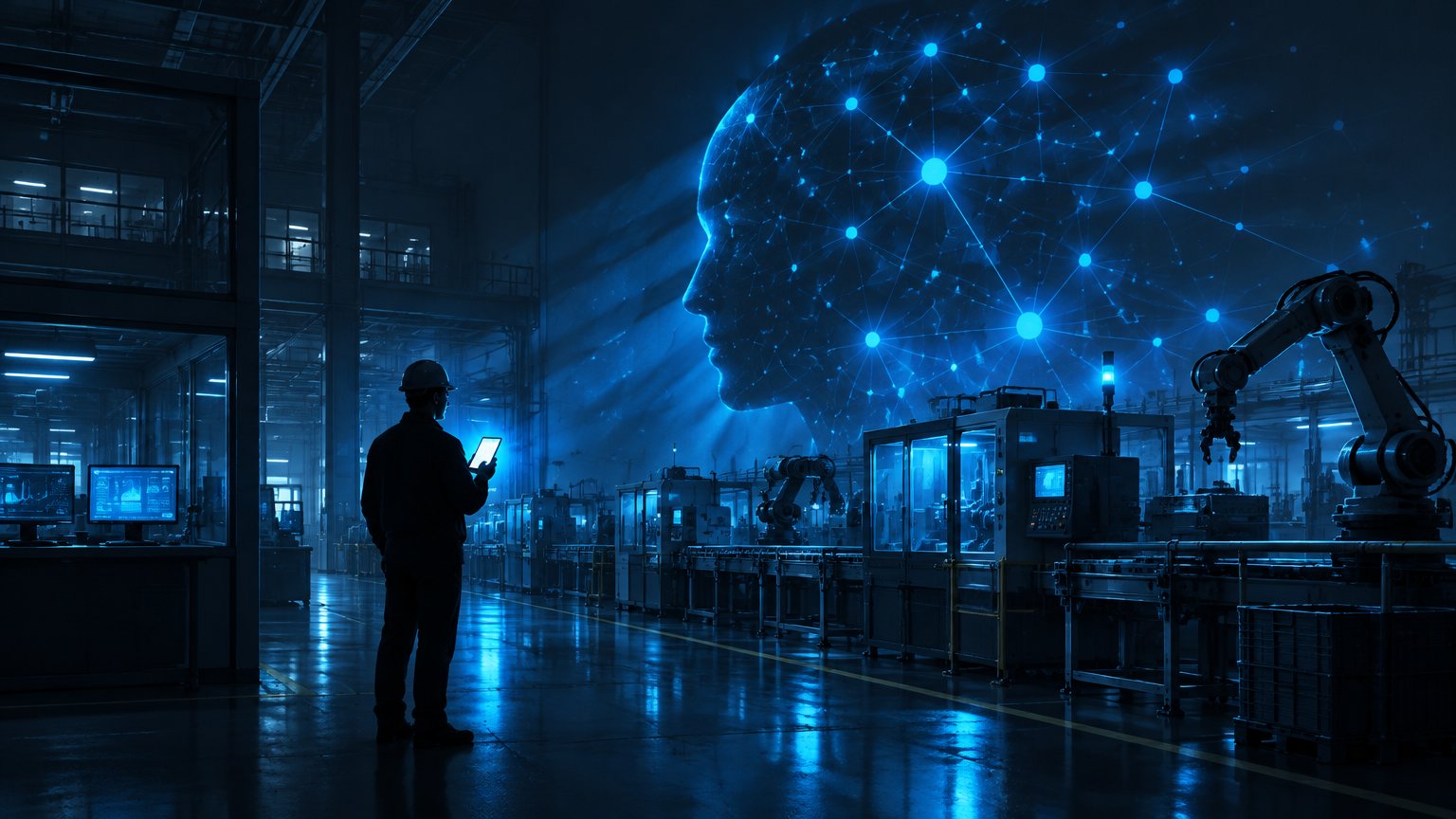
It's 2:40. The line is down.
Marek is thirty-eight years old with twelve years in maintenance. It's Tuesday, third shift. Line three has stopped on a servo drive with fault code F-27 — nobody on the shift has seen that code in two years. The on-call IT engineer picks up no earlier than seven. The vendor's service works weekdays. Four operators are standing on the floor, and every hour of downtime costs more than Marek earns in a month.
Marek does what any good engineer would do in 2026: he pulls out his phone, photographs the technical documentation page with the fault-code table, pastes the last hundred lines of controller logs, and writes to a free AI assistant: "line down, code F-27, what to check first." The answer comes in nine seconds: encoder, parameter P-114, reset. At 3:05 the line starts moving. At 3:12 Marek goes for coffee with the feeling that he saved the shift. Because he did.
Nobody did anything wrong that night. And that is exactly why the story is dangerous: at the same time the line got back into rhythm, something left the factory that can never be recalled — page 214 of the technical documentation with the vendor's fault-code table and factory settings, plus a log containing RECIPE_ID 4471-B and ORDER 88213 / KLIENT_A. Straight to a private account on a public AI chat whose terms say it may learn from whatever you paste.
The numbers that should worry you
- 78% of employees using AI at work bring their own tools (Microsoft WTI, n = 31,000)
- 89% of AI usage in companies is invisible to security teams (LayerX, 2025)
- 8.2 GB of data per month flows out of a single organization to unauthorized AI tools (Netskope, 2026)
- 43% of breached organizations had a shadow-AI incident — a year earlier: 20% (IBM/Ponemon, 2026, n = 602)
This is not a fringe problem. Australia's national science agency CSIRO surveyed 27 critical-infrastructure operators: 26 of them had observable shadow AI. And according to KPMG, in a Polish sample of 1,082 respondents, more than half of those using AI at work do not disclose it and present the results as their own.
Anatomy of the mistake. Why did Marek do it?
Before you reach for the policy handbook, step into Marek's shoes for a moment. If your first thought is "a breach of discipline", you have just made the second mistake of that night. It will cost more than the first one.
Marek had a choice: wait four hours for the on-call IT engineer, call a service desk that will not pick up, or ask a tool he knows from home — the same one he uses to plan holidays and check his kids' homework. According to PagerDuty, 89% of employees first discovered an AI tool privately and only later brought it to work. They did not get it from the company — they brought their own, like a screwdriver that fits the hand better than the one from the tool crib.
Marek is not a saboteur. Researchers call people like him a "constructive-intent threat": the employee means well, and that is precisely why they expose data. A study of 357 Swedish physicians reaches the same conclusion from the other side: unauthorized AI use is a signal of unmet professional needs, not disloyalty. The doctor asks a chatbot about a diagnosis because they want to help the patient. The mechanic pastes the fault code because the line is down. Both take on a risk they do not understand in pursuit of a goal they understand perfectly.
Look at the PagerDuty and Wakefield numbers (n = 1,250): 81% of employees believe leadership plays by different AI rules. 77% believe restrictions hurt their career development. 72% believe they understand AI better than their company's technology department. 28% use shadow AI simply because the company offered no alternative. Sharp Europe adds that 44% of managers in Europe use AI secretly to appear more competent. Marek watches how his bosses behave and draws conclusions.
There is also the mechanism researchers call the paradox of risk and benefit distribution. The benefit is immediate and personal: the line moves, Marek is the hero of the shift. The risk is deferred and organizational: the recipe leak will hurt in six months, someone else, in another department. No human being wins against that asymmetry at 2:40 in the morning. A CSIRO respondent put it in a sentence worth memorizing: "If you don't give them the tools, they'll find a way to get the tools."
Shadow AI is not a breach of discipline. It is a signal that something is missing from your infrastructure — something Marek had to improvise on his own. People like him are your most ambitious efficiency hackers; instead of punishing them, go find them.
What you will find in the full report
The "Shadow AI in Manufacturing" report (39 pages, about 25 minutes of reading) takes this single night apart and shows the way back:
- The risk cascade — four people, four currencies: the engineer, the production manager, the CFO and the CEO each pay for that night in a different way
- The reflex that makes it worse — why banning AI increases exposure instead of reducing it
- Stepping out of the shadows — the rescue plan: find your hidden AI champions, one policy instead of ten bans
- The "what may be pasted where" matrix and three rollout horizons: today, this quarter, in 12 months
- What it looks like when it works — the architecture: read-only data through a DMZ, three digital experts (assist, resolve, observe), a model that sees the ticket but not the client
Daniel Stram (Head of Sales) and Jakub Duda (CTO, co.brick AI)